






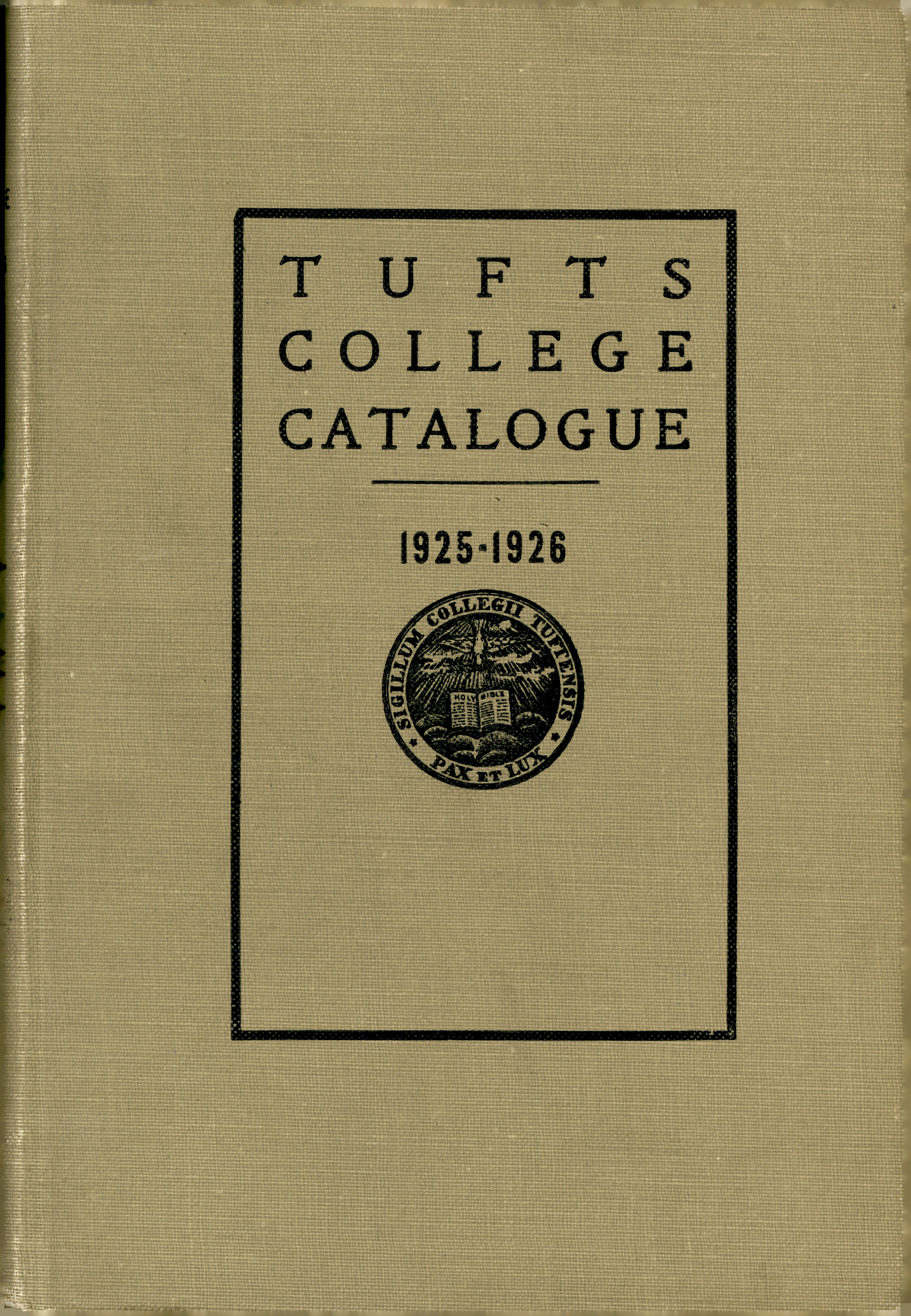
This featured collection is one that can sometimes go unnoticed amongst TARC’s flashier university records. However, it contains information that’s invaluable for research on anything from the evolution of emerging academic disciplines to the changing social conventions throughout Tufts’ history. This collection is also one of our easiest to access— simply drop by the Reading Room, and you’ll find them all on shelves against the north wall. Additionally, TARC’s digitization team is currently working to make them fully available online.
Let’s explore UP005, TARC’s collection of Tufts Combined Catalogs, Bulletins, and Course Announcements.
Catalogs, Bulletins, and Course Announcements? What’s the difference?
For those unfamiliar, “catalog,” “bulletin,” and “course announcements” can all be used to describe the list of courses that a university makes available before each semester for current and prospective students. While this information is generally released online today, in previous years students would need to pick up a physical list of courses to plan their registration for the following semester. These publications could also contain information about departments, faculty and staff, degree requirements, tuition and expenses, and rules and regulations.
For our purposes, we will use “bulletin” to refer to this type of publication at Tufts.
Naming conventions for the Tufts bulletin have changed over the years. What began in 1854 as a “catalog” (or more specifically, the Catalogue of the Trustees and Officers of Tufts College with the Course of Instruction, &c., 1854-‘5) officially became a “bulletin” in 1956, and in 1970 Tufts stopped printing a combined list of course listing for its schools altogether, instead making it each school’s responsibility to do so individually. For example, AS&E bulletins from after 1970 can be found in a separate collection, UP006, Arts and Sciences and Engineering Bulletins.

What’s in a bulletin?
The location of information on university rules, student resources, and social conventions also fluctuated over the years. The earliest Tufts bulletins combined all of the above into one publication. The 1854 bulletin listed Tufts faculty, administrators, trustees, admission requirements, curricula, social and religious requirements, schedules, expenses, and train directions all within 15 pages. It helped that there were only 7 full-time faculty members at the time, and that there was very little choice between the college’s offering of just under liberal arts 60 courses in total. Finally, for those who are morbidly curious, tuition was $35.00 per year.
By 1925, the bulletin’s course offerings had grown exponentially and included those offered by the Graduate and Undergraduate Schools of Liberal Arts and Engineering, Jackson College, the Bromfield-Pearson School (a pre-college engineering prep school), Crane Theological School, and the Schools of Medicine and Dental Medicine. At this point in time, bulletins also included registers of current students listing their full names, courses of study, hometowns, and campus addresses. However, rules and guidelines for campus life are missing.
Starting in 1902, the Ivy Society, the junior class honor society for the School of Arts and Sciences, began publishing the Ivy Book. The Ivy Book was a college handbook meant, according to its foreword in 1952, “to provide in a convenient form official and nonofficial information about the College.” It described extracurricular activities, yearly traditions, campus resources, local restaurant and retail recommendations, tuition, and more. In 1977, the Ivy Book was replaced by the Pachyderm, an equivalent publication created by university administration instead of students alone. Course listings, meanwhile, stayed behind in the bulletin.
Jackson College, the “coordinate” Tufts women’s college which existed separately from 1910-1980, also had its own handbook. These contained similar information to the Ivy Book and Pachyderm, but with some fun, gender-specific flavor. This includes passages such as:
“Article II – Social Privileges (Jackson Regulations, 1949)
Students are expected to exercise proper discretion in their social activities, and to realize that lack of judgement in this respect reflects not only on them individually but on the College as a whole. (…) the class of a student is determined by her official standing as recorded in the administrative office.”
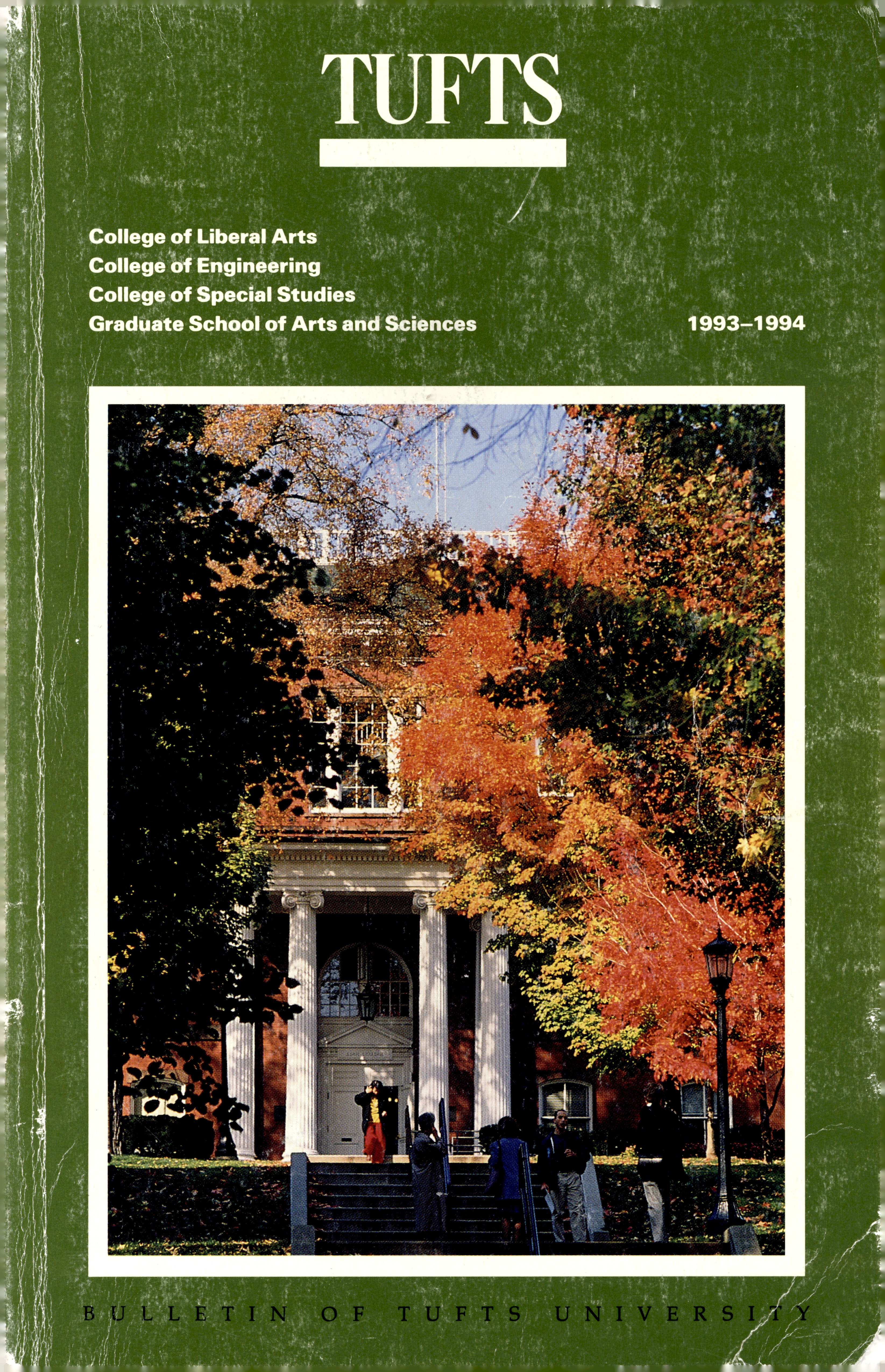
Modern bulletins, such as the one published in 1993, are overall more detailed than their predecessors. They leave out handbook information and student lists, instead spending much more time on course descriptions, faculty, and degree requirements. It is in these later bulletins that evidence of diversification of areas of instruction can be found, with newer departments such as Ethnomusicology and Urban and Environmental Policy growing their course offerings every year.
See for yourself!
Bulletins can reveal all kinds of information about life as a member of the Tufts community. They help us keep track of changes in academic trends and reveal key information about students through the years. For instance, the full student names and addresses findable in early bulletins have been essential to TARC and the Slavery, Colonialism, and their Legacies Project in researching the lives of early students of color.
Current students are encouraged to look back on older bulletins to see how they might’ve experienced Tufts in the past, and Tufts alumni can learn a lot about how Tufts has changed by looking at current editions.
Visit us online at archives.tufts.edu or in person at our public offices on G floor of Tisch Library to learn more.