






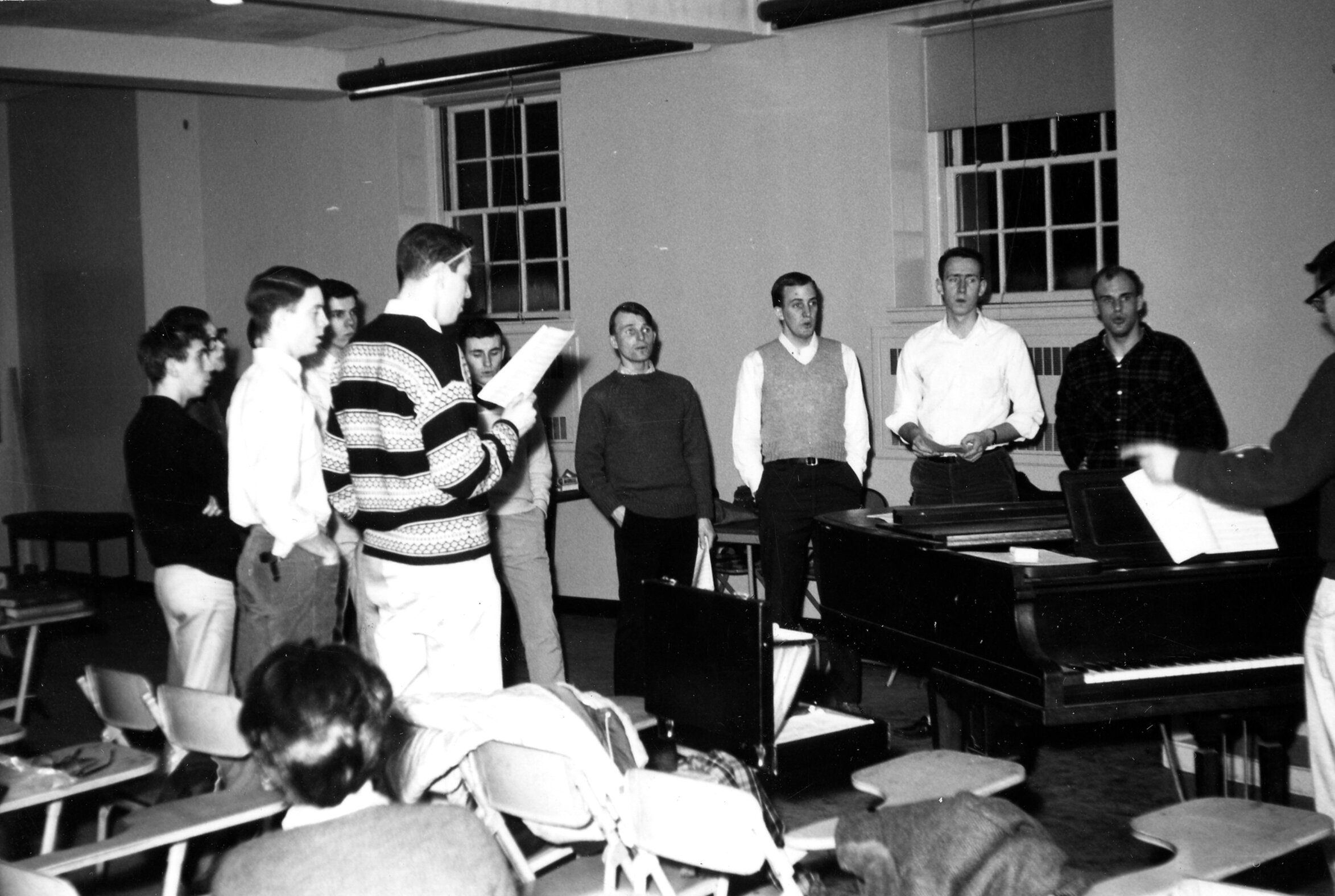
Box 003 of the Activities and Organizations records at the Tufts Archival Research Center is relatively unassuming at first glance. It’s a thin, gray box that only stores a few folders, all of which are related to student organizations from throughout Tufts’ history that start with the letter B. For some, it may be hard to imagine that this box contains newspaper headlines about nationwide concert tours, album releases, and the 1964 World’s Fair. What are these articles doing in this box? What could all these things possibly have in common?
That would be the Beelzebubs. Or, as they are commonly and affectionately referred to, the Bubs.
So... who are the Bubs? As one 1976 Tufts Observer article put it, “What exactly is a Beelzebub? A South American monkey? A prince of demons?”
Here’s what TARC’s documentation on the Bubs has to say about who they are and what they do:
“The Beelzebub tradition began in the winter of 1962 and the status of the group has grown considerably in a brief time. The 12-man a capella group is selected each spring from male undergraduates on the Hill. They stress quality in their choice of music and provide a variety of material trying to impress on their listeners their main purpose—fun through singing.” (Beelzebubs concert program, ca. 1960s)
“Staying away from the classical, a Beelzebub concert includes jazz numbers, popular music, perennial favorites such as “Stairway to the Stars,” “Just the Way You Are” and “Lullaby of Broadway,” old Beatle numbers, folk songs, barbershop selections and even rock ‘n roll when a song can be arranged to fit the demands of an all-male group with no musical accompaniment.” (“Beelzebubs to Perform at World’s Fair,” Tufts Weekly, 1964)
"Beelzebub is an old Hebrew word meaning ‘messenger of the devil.’ Today, it is also clearly associated with the devil. If it can be related to a group of fun-loving people who wish to bring good entertainment to others, then it certainly suits the twelve young men who recently entertained the students of Bristol Central High School.” (Letter from N. Lawrence Kellett, business manager of the Bubs, to Tufts Office of Public Relations, 1965)
The Bubs first appear in The Jumbo, Tufts’ yearbook, in 1964 (although the name of their club was unfortunately misspelled as “Beezlebubs” – an error afflicting many records that mention the group). While many a cappella groups in the 60s focused on barbershop and classical music, the Bubs instead had “a varied repertoire which include[d] folk songs, barbershop, show tunes, spirituals, novelties and original arrangements.” Perhaps due to their mission of fun through singing, the Bubs differentiated themselves not only through the type of music they sang, but also the types of shows they put on. A program from one of their earliest concerts had this to say about what a Bubs show looked like in the mid-60s:
“Fine music accounts for only part of the Beelzebub success story, however. The remainder derives from the Beelzebubs’ unusual flair for showmanship, which provides at each concert a continuous stream of light diversions forming an integrated performance in themselves. The result? Any audience, ranging from the most avid music lovers to the hopelessly tone-deaf, can join with the Beelzebubs in having a ball at each concert.”
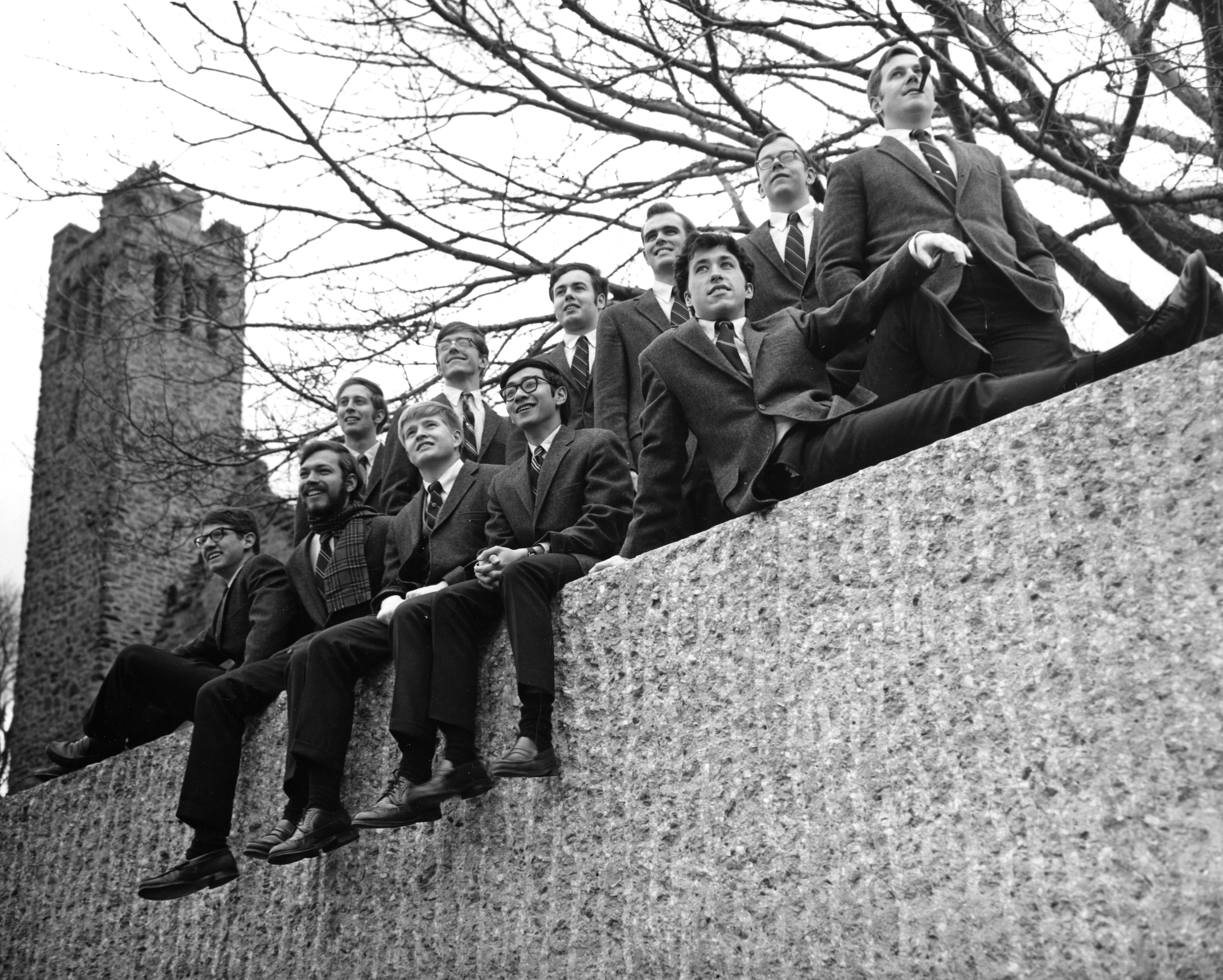
It seems that this “flair for showmanship” persisted through the 80s, with a 1981 Journal Tribune article noting that a Bubs show often seemed like less of a “traditional” choral performance and more like a “variety show,” often implementing costumes, comedy, and choreography. “Their performances are such a departure from the expected and so entertaining that the Beelzebubs are regarded as a cappella pacesetters.”
Since then, the Bubs have become a staple of the a capella scene not only at Tufts, but internationally, even performing for TV shows such as Glee and purportedly serving as the inspiration for the Treblemakers in the 2012 movie Pitch Perfect. So how did the Bubs go from a casual singing group in the winter of 1962 to being featured on Glee 50 years later?
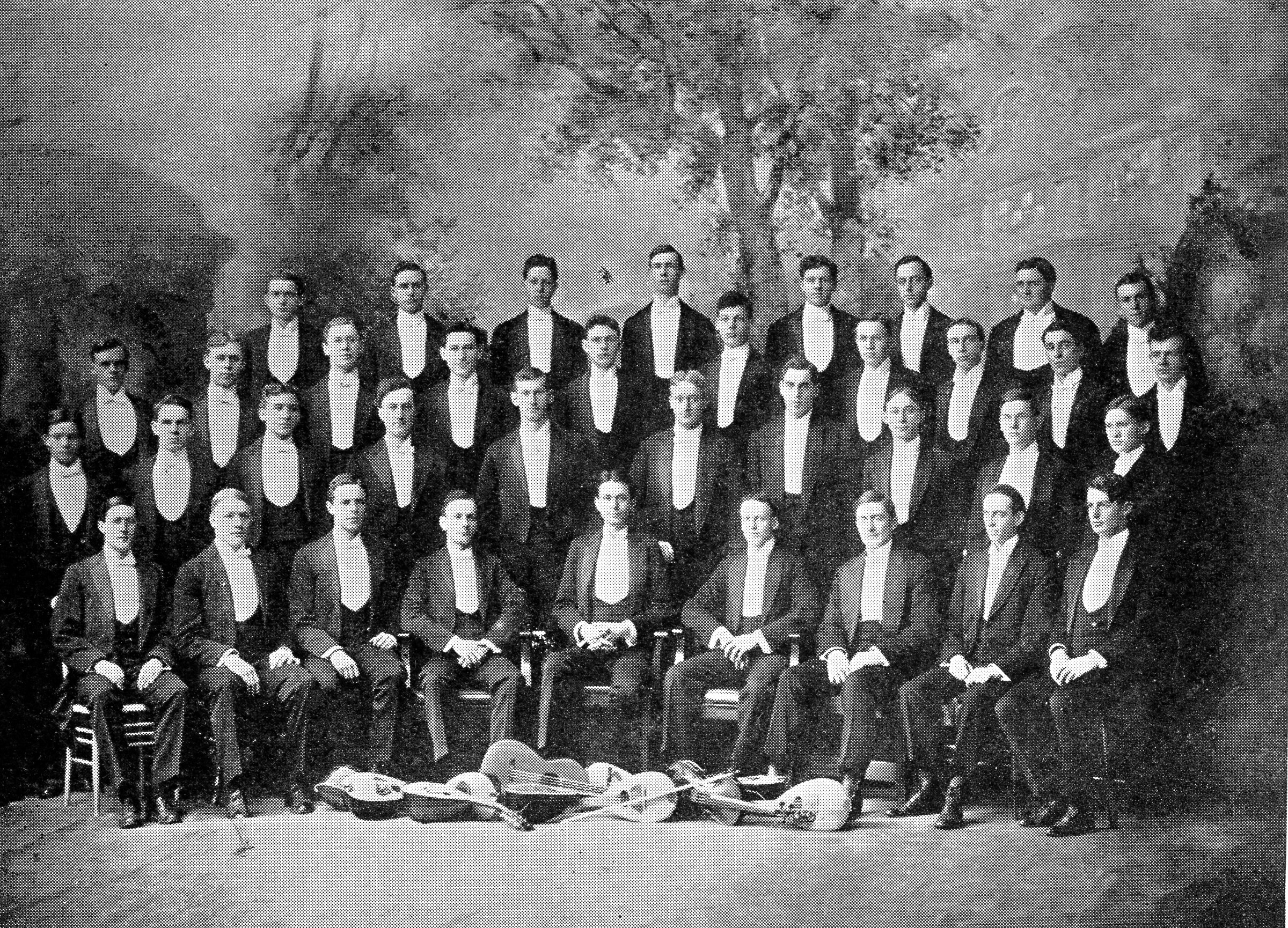
To answer this question, perhaps we should take a look at Tufts’ extensive musical tradition. In Light on the Hill: A History of Tufts College, 1852-1952, Russell Miller notes that “music has always played an important part in the life of Tufts students. For many years at the turn of the century the institution was known as ‘the Singing College’” (386). Tufts student newspapers and yearbooks chronicle the numerous groups that sang for fun during the late 19th and early 20th centuries, such as the Glee Club and the women’s All Around Club. A 1917 Tufts Weekly article on the Glee Club further details the deeply entrenched history of singing on Tufts’ campus:
“Since 1886, the Tufts College Glee Club has existed as it exists today, a well-organized, thoroughly trained musical association, but as far back as 1859 there are records of a quartet which furnished music on the Hill. In 1876-1877, a quartet composed of men of uncommon musical ability, and having an extensive repertory, traveled as far as Maine and founded the reputation which Tufts has ever since enjoyed for excellence in music.”
Singing brought students together, whether it was for entertainment, extracurricular involvement, or just good old-fashioned school spirit. Students were able to identify with each other through song, especially after the publication of the Tufts Song Book (which you can view in our Reading Room any time we’re open!) in the early 20th century. A 1909 Tufts Weekly article made a case for the beloved Tufts Song Book being a perfect Christmas gift:
“To the undergraduates and alumni who are looking about to obtain suitable gifts for Christmas presents, we suggest a copy of the Tufts Song Book. The book is probably the most complete college song book ever published, for it contains many of the standard college songs in addition to the local ones. Every Tufts student should feel it an obligation to purchase a copy and learn the words and music of the songs which have given Tufts [pre-eminence] in these lines. Don’t delay in ordering your copy!”
Nearly fifty years later, a 1963 Tufts Weekly article examining the then newly-formed Beelzebubs stated that there was a “general lack of organized, four-part harmony-singing on Campus"--but “determined to do something about [this] situation, [the Beelzebubs] sought out others who shared their love of singing.” Lo and behold: the culture, tradition, and spirit of “the Singing College” persisted. It is carried on year after year by not only the Bubs, but the numerous modern singing groups on Tufts’ campus such as the Jackson Jills, the Ladies of Essence, the Amalgamates, and others—but that might be a story for another blog post.
TARC’s records offer a valuable perspective on the Bubs’ rise to the top of the international a cappella scene. Their most quintessential moments and impressive accomplishments truly come to life in newspaper articles, concert programs, photographs, correspondence, and other pieces of ephemera held at TARC. Perhaps the most interesting insight this documentation highlights is how the Bubs, along with the rest of the world, have evolved over the last 60 years—from performing in high school auditoriums, to being played in space. For more information, be sure to check out the Beelzebubs Records (UA238) and Activities and Organizations Records (UA024) at TARC!