






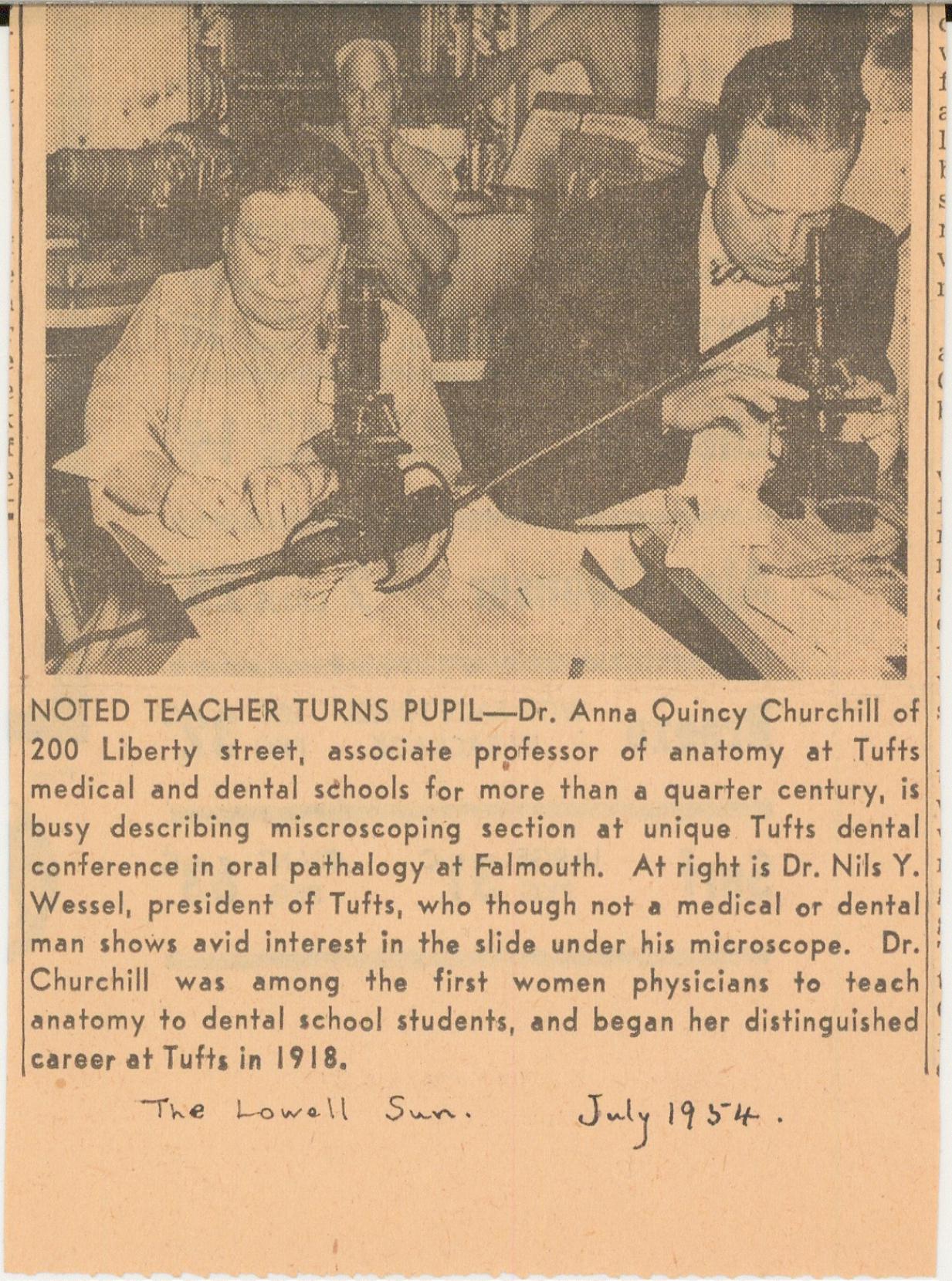
“What do you want with a microscope? You ought to go home and learn to stir with a spoon!” This was what Dr. Anna Quincy Churchill (1884-1971) was told when trying to purchase her first microscope as a new college graduate in 1907.
Born in Dorchester, Massachusetts in 1884, Anna was the daughter of Judge Joseph Richmond Churchill and Mary Cushing Churchill. Her father was an avid amateur botanist, and her grandfather, Dr. Benjamin Cushing, was a medical doctor. These two figures are credited in later newspaper accounts of her life with having instilled in Anna a love of science at an early age. It was a love of science and anatomy that propelled her to graduate from Smith College with a degree in Zoology in 1907. Then, refusing to listen to comments suggesting she was better suited for work in the kitchen, Anna went on to earn a master’s degree in biology from Radcliffe College in 1910, before entering the Tufts College School of Medicine in 1913 as a member of the class of 1917.
After finishing her schooling, Dr. Churchill completed a year of service in a hospital and passed her state board exams, which allowed her to practice medicine in her community. However, Dr. George A. Bates, Professor of Microanatomy at Tufts, asked her to return to the school to teach with him, to which she agreed. This began a 37-year career at Tufts that would see her teach microscopic anatomy, histology, embryology, neurology, and gross anatomy to hundreds of medical and dental students, as well as to students at the Sargent School of Physical Education and the Forsyth School for Dental Hygienists. Dr. Churchill was to become a beloved mentor to countless Tufts students, many of whom became lifelong friends. She would even go on to live most of her life with one of her former students, Dr. Gertrude Flint Frisbee, M1928, with whom she shared a home for more than two decades.
Anna stated several times throughout her life that she never regretted teaching over actively practicing medicine, and it is clear from the archival traces she left behind that she found immense joy in working with students. Much of the small amount of correspondence TARC holds from Dr. Churchill concerns the establishment of monetary prizes by herself and Dr. Frisbee, to be awarded to students of zoology and botany. These letters also describe her plans to donate the remaining funds from her family’s estate to Tufts upon her death. A few letters even show her writing to the Tufts administration, promising to cover the cost of tuition and supplies (such as microscopes) for promising students who found themselves in financial trouble.
After she officially retired in 1954, and after a year of donated teaching time in 1955 (Dr. Churchill helped out for a year so the Department of Microanatomy wouldn’t be shorthanded after her retirement), a news article held by TARC describes her dedicating her new free time to visiting former students and maintaining friendships. Her other hobbies included bird watching, caring for pets, attending the Boston Symphony, and continuing to work with her microscope at a small desk set aside for her in the Department of Anatomy.
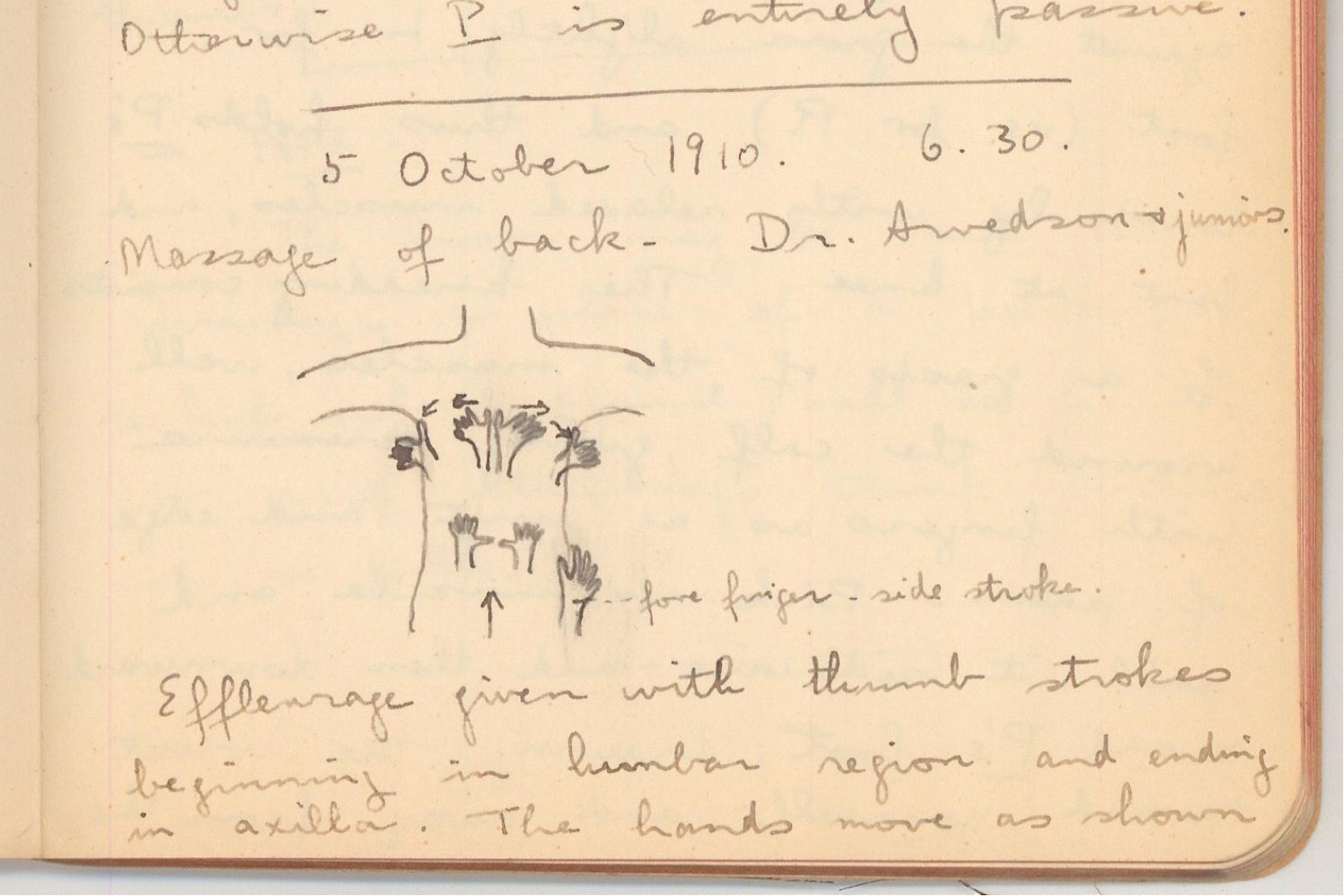
It is from the earliest days of her medical education, though, that TARC retains a fascinating set of artifacts belonging to Dr. Churchill. In 1910, between finishing her master’s studies at Radcliffe and entering medical school at Tufts, Anna traveled to Germany and Sweden to study medical gymnastics and massage techniques for the treatment of scoliosis, rheumatism, and bone disorders. She documented her studies in a series of five notebooks now held in TARC’s School of Medicine Records. In addition to handwritten notes taken during lectures by leading physicians in the field, the notebooks also contain photographs of various subjects. These photos depict the instructors she studied with, treatment spaces, and children partaking in medical gymnastics treatments. Considering that Dr. Churchill would go on to impart her medical knowledge to countless professionals over the course of her career, it is fascinating to see even a small part of the way in which her own studies began.
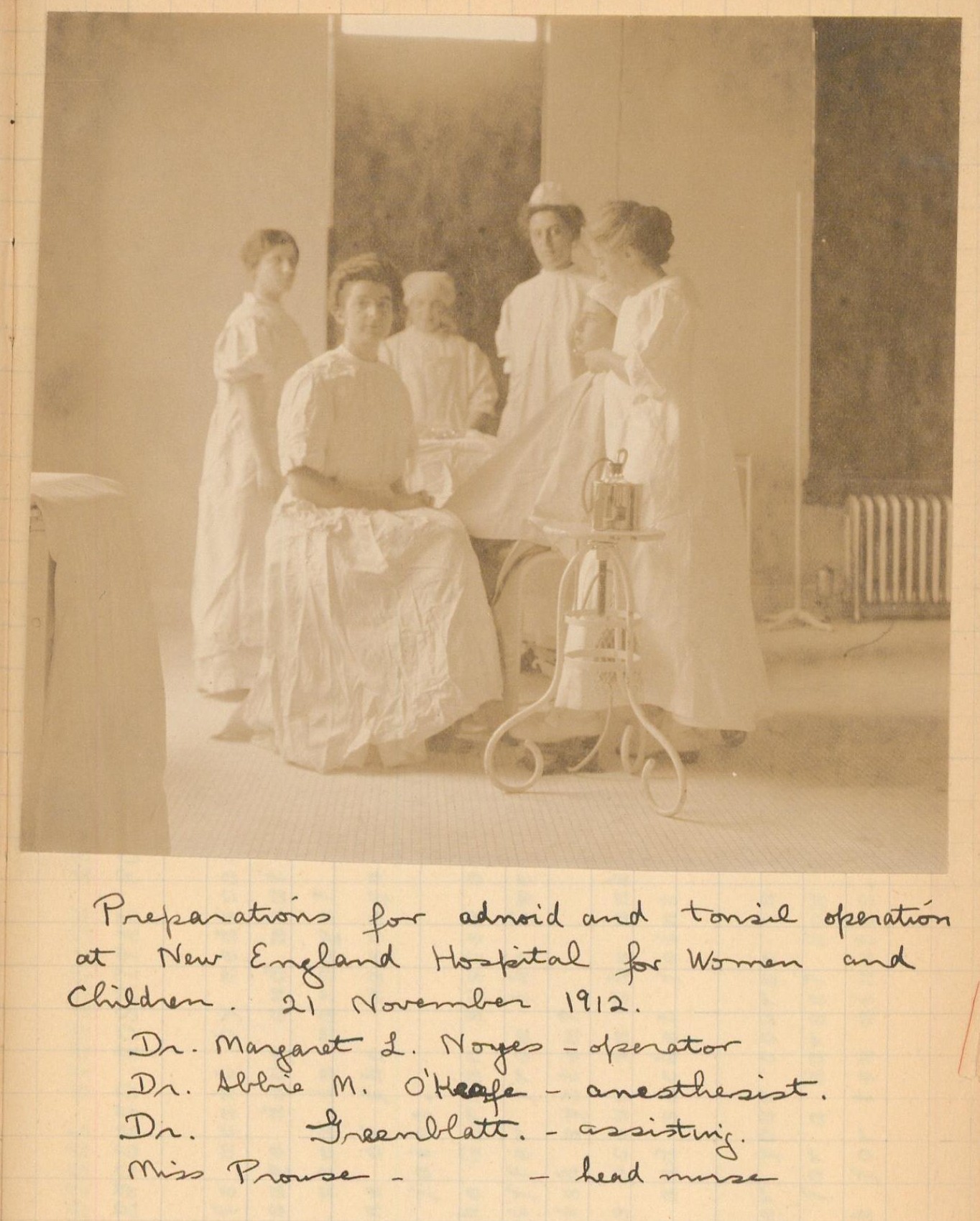
Dr. Churchill documented her time studying with several medical professionals in Europe, including Ingrid Wiksell, a female healthcare provider in Sweden with whom she studied medical massage. Also included in one of the notebooks is a 1912 photograph of an all-female surgical team preparing to conduct an adenoid and tonsil operation at the New England Hospital for Women and Children – a rare image of women leading a medical team at a time when it was extremely uncommon. According to the Association of American Medical Colleges, there were only about 6,000 female physicians in the whole United States in 1915. It is, perhaps, unsurprising that a female doctor of this time would seek out others like her to learn from and commune with, but the rarity of materials related to women in the medical profession in the early twentieth century makes Dr. Churchill’s notebooks particularly interesting. It isn’t hard to imagine the difficulties faced by women who wished to become doctors in this period, but it makes the reality of Churchill’s situation much more tangible when we examine her experiences through the lens of her own handwriting. Anna herself stated in a piece written for the Tufts Medical Alumni Bulletin in 1949 that it was only, “because Tufts has an open door for women, there was fulfilled the great desire of my childhood to study anatomy and eventually to teach it.”
Luckily for us, and for countless Tufts medical students over the years, the scarcity of females in her profession never seemed to discourage Dr. Anna Quincy Churchill. Instead, it seems to have inspired her to become a professor of medicine and to spend 37 years educating future physicians (of all genders!) at the Tufts School of Medicine and the School of Dental Medicine. And, thanks to her notebooks and correspondence, Tufts staff and scholars continue to benefit from her wisdom, kindness, and inspirational spirit.
Sources:
"Anna Quincy Churchill's notebooks,” 1910-1912. UA010, School of Medicine Records.
AAMC. A brief timeline of women in Medicine | AAMC. Accessed June 26, 2026. https://www.aamc.org/news/brief-timeline-women-medicine.
“Churchill, Anna Q. M'17 (former faculty),” 1944-1971. UA073, Vertical File Collection.
Flaherty, Julie. “She Could See Worlds in a Cell, and Boundless Promise in Her Students.” Tufts Now, March 21, 2022. https://now.tufts.edu/2022/03/21/she-could-see-worlds-cell-and-boundless-promise-her-students.
“Tufts Medical Alumni Bulletin,” 1949-06. UP007 Tufts Medicine.